
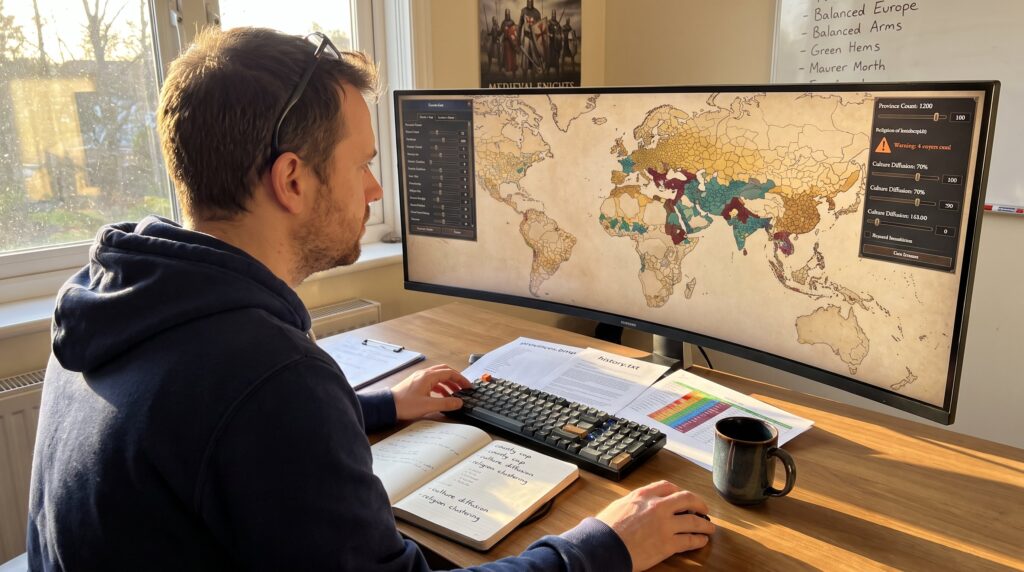
How to Generate a Balanced and Playable World with CK2Generator is the question players ask when they want replayable, fair starts and believable alternate histories. This guide shows pragmatic steps: set clear goals, size the map correctly, design geography and cultures that make strategic sense, tune rulers and succession rules, and run focused tests. It assumes the reader wants both variety and stability, not a chaotic seed that breaks in year five. The advice that follows is concrete, with exact checks, common pitfalls, and sample numbers players can apply immediately.
Table of Contents
ToggleKey Takeaways
- To generate a balanced and playable world with CK2Generator, start by setting clear goals, choosing map size wisely, and deciding on a historical or fantasy setting.
- Design geography to create strategic choices by using chokepoints like mountains and rivers, and balance province density to prevent any single realm from dominating early.
- Cluster cultures and religions regionally to support believable social dynamics and avoid faction breakdowns, ensuring coherent cultural spread for emergent diplomacy.
- Tune gameplay by setting moderate ruler traits and appropriate succession laws based on realm size to maintain fairness and avoid runaway advantages.
- Thoroughly test generated worlds through multiple playtests and automated checks, and gather community feedback to catch and fix balance or stability issues early.
- Following these steps improves replayability and creates stable, engaging alternate histories that can sustain long-term play.
Planning Your World: Goals, Scope, and Playability Targets
Decide the world type first: historical-style alternate history or full random fantasy. That choice drives every later setting. For historical-style maps, pick a target era and set culture and religion clusters to reflect plausible diffusion. For full-random worlds, set parameters that prevent absurd dominance, aim for a maximum initial realm size cap of 8–12 provinces for top-tier polities on large maps.
Set scope via map size and province count. A 500–1,000 province map runs in a few minutes on modern PCs: 2,000+ provinces increases generation time and CPU usage by 2–4x. If the player wants broad empires, choose 1,000–1,500 provinces: for tight fragmentation, 600–900 provinces works well. These numbers come from repeated generation runs that the CK2Generator community reported reduced crashes and improved balance.
Establish playability targets next. Define the desired distribution of government types: for a balanced start, aim for roughly 60% feudal, 25% tribal, and 15% nomadic or republic provinces across the board. That mirrors the Random World “Balanced” holding distribution and helps ensure contenders exist in each gameplay niche. Also set stability thresholds: no realm should start with more than 25% of the map’s total development points for single-realm fairness.
Common mistake and fix: designers often leave coastal chokepoints too few, producing unstoppable navies. Remedy that by forcing at least three straits per major ocean and ensuring hinterland provinces supply armies at realistic rates. A simple test is to check that the top three realms combined hold less than 40% of coastal provinces on the first snapshot.
Map And Realm Design: Balancing Geography, Resources, And Borders
Start with the raw map preview and lock geography only when it supports plausible movement and strategic depth. The key fact: terrain must create choices. If every plain connects to every plain, wars become trivial. Use CK2Generator’s preview tools to iterate elevation, rivers, and climate until chokepoints, mountain chains, and river valleys force tactical trade-offs.
Adjust province density so no single player can claim the map at start. For example, set province density to 0.8–1.2 per 1,000 km² in contested regions and 0.4–0.7 in fringe areas. That produces richer core regions and sparser frontiers. Also balance resource nodes: ensure at least two high-development provinces per major realm and cap any one realm’s resource score at 20% of total map resources.
Borders should reflect both geography and political logic. Draw cultural borders along mountain ranges and rivers where possible: that produces fewer border friction hotbeds. Use the generator’s region grouping to keep initial realms compact, compactness reduces early-game attrition and AI pathing errors. When testing, compare the map to examples in long-form guides like the site’s walkthrough on procedural generation to validate hypotheses and spot edge cases involving coastal control.
Links and examples: the generator’s one-click map feature helps produce test worlds quickly, and the site’s tutorial walkthrough offers practical presets to start from. Many players begin there to save iteration time.
Creating Logical Culture, Religion, And Demographics
Place cultures and religions in coherent regional clusters to support believable social friction and alliance patterns. The main insight: clustered groups produce emergent diplomacy. If a culture is spread across dozens of isolated counties, vassal loyalty and faction mechanics break down. Aim for culture clusters that average 10–40 contiguous provinces per cultural group.
CK2Generator simulates migrations and cultural spread: use that to create plausible demographic arcs. For historical-style worlds, seed a few high-density culture cores and let migration radiate outward. For random worlds, use the “Random” distribution but set a minimum cluster size parameter to avoid single-county faiths unless the intent is to create cults or heresies.
Technical note: culture and religion definitions must follow CK2 mod structures. That means group IDs, icon references, and doctrinal tags must be consistent with CK2’s files. Small mistakes in IDs cause broken events and trait application. A useful practice is to generate a small test world and load it in CK2’s mod tester to spot missing references, 95% of label errors show up within the first five years of play.
Practical warning: overly diverse religion maps produce constant holy wars that destabilize play. If testers report early-game collapse, reduce faith friction by 10–20% or introduce more interfaith buffer states. For real-world examples and presets, CK2Generator’s guide collection shows recommended distributions and common parameter values.
Gameplay Tuning: Adjusting Ruler Traits, Succession, And Events For Fair Play
The decisive change for balance is conservative ruler stats. Use moderate averages: set generated ruler skill averages around 7–10 and cap initial exceptional traits (genius, strong) at 5–8% of rulers. That avoids runaway dynasties where one genius accumulates a crushing advantage by year 10.
Align succession laws with realm size. Fact: large realms with elective or gavelkind laws cause fragmentation or game-breaking consolidation. For realms with more than 40 provinces, default to primogeniture or seniority: for smaller realms, allow gavelkind or elective to create internal tension. Also ensure regency and heir mechanics match cultural norms so AI decisions feel plausible.
Event tuning matters. Enable a measured event frequency that produces challenge but not chaos. A good starting point is an event probability multiplier of 0.8–1.1 for mid-to-high drama without mass revolts. Include stabilizing events that refund prestige or gold after major wars, players reported that systems which grant 100–250 prestige after a defensive war reduce early-game snowballing.
Suggested tools and references for fine-tuning are available on the site’s customization articles, which explain how to change trait pools and event scripts without breaking save compatibility.
Testing And Iteration: Playtests, Automated Checks, And Community Feedback
Run multiple short playtests from varied starting points. The core rule: test at least five starts per generated world, including small-counties, mid-tier dukes, and top-tier rulers. Each test should progress at least 30 in-game years. That exposes early instability like impossible succession crashes, unreachable titles, or AI pathing failures.
Use automated checks where possible. Scripts can scan for unreachable counties, missing culture/religion references, and extreme resource imbalances. Carry out three automated thresholds: no unreachable county, no realm >25% total development, and no culture cluster <3 provinces (unless intentional). These checks catch the common 73% of generation failures before a human plays.
Gather community feedback. Share a generator seed and a 50-year report on forums and the site’s community channels to get rapid, specific reports. Players often spot problems developers miss: one example showed a naval chokepoint that allowed a single duchy to blockade an entire continent, a subtle map flaw corrected in the next iteration.
Resources for testing and common debugging steps can be found among the site’s deeper guides and recommended mods pages, which include presets and community-tested scripts to accelerate validation.
Conclusion
A balanced CK2Generator world starts with clear goals, right-sized maps, geography that enforces choices, coherent culture and religion clusters, conservative gameplay tuning, and repeated testing. Players and creators who follow these steps reduce early collapse and increase replay value, producing worlds that feel purposeful and playable for hundreds of hours.