
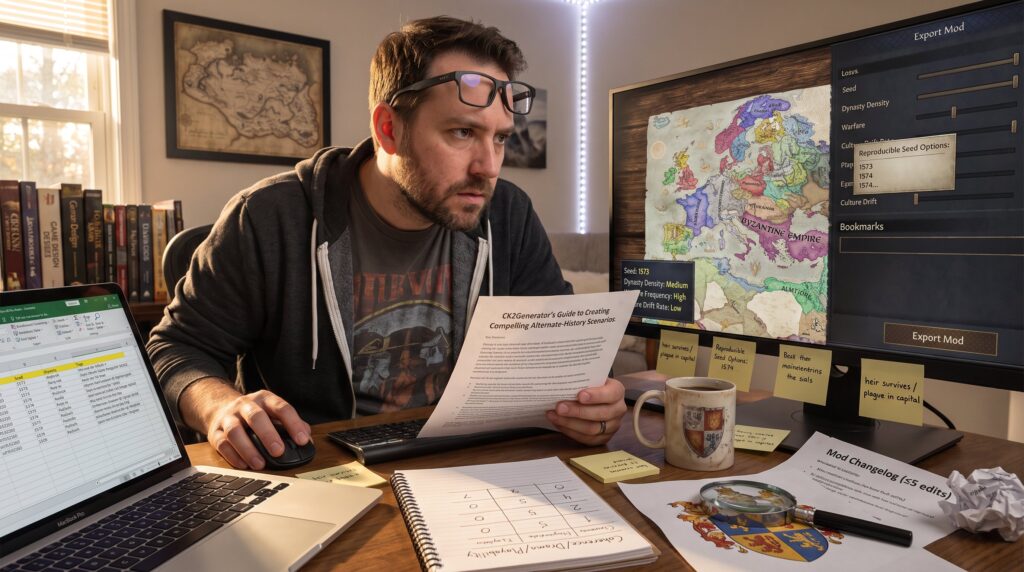
CK2Generator’s Guide to Creating Compelling Alternate‑History Scenarios opens with a promise: design worlds that feel lived in and logically changed. Gamers want familiar hooks and surprising turns. This guide explains how to pick a convincing divergence, map ripple effects, and turn the result into playable maps, factions, and characters. It assumes basic knowledge of grand strategy design and is aimed at players and modders who want scenarios that reward exploration, roleplay, and competitive play.
Table of Contents
ToggleKey Takeaways
- CK2Generator’s guide emphasizes choosing a plausible and narratively significant divergence point to create compelling alternate-history scenarios.
- Mapping ripple effects in stages—from immediate political changes to long-term social and technological shifts—helps maintain plausibility and depth.
- Using CK2Generator’s seed-based tools ensures consistent reproduction of alternate timelines for testing and balance.
- Alternate-history scenarios engage players by balancing familiar elements with surprising outcomes, enhancing exploration, roleplay, and competitive play.
- Anchoring changes in real historical details and stable institutions increases immersion and player investment.
- Careful design of maps, characters, and factions with coherent geography and history seeds enhances replayability and storytelling.
Why Alternate History Works In Games — Player Appeal And Design Opportunities
Fact first: alternate history succeeds because it balances familiarity with novelty. Players recognize names, symbols, and events but then see different outcomes. That recognition reduces cognitive load and increases emotional stakes. Design advantage: a changed past gives the player meaningful choices without inventing a wholly alien setting.
Players play alternate-history scenarios for clear reasons. They enjoy testing “what if” hypotheses, rewriting famous moments, and exploring consequences. Competitive players like the unpredictability: roleplayers like new character hooks. For designers, alternate history offers reusable mechanics, familiar institutions (churches, dynasties, trade) can be repurposed with new alignments.
A practical note: expectation management matters. If the game teases historical accuracy, players will compare divergences against real events. Designers should anchor changes to a few believable constants (geography, survival of major cities) to keep the world coherent. CK2Generator helps by exporting consistent maps and history seeds, letting modders regenerate the same alternate timeline for testing and balance. For contextual reading on generator tools, an in‑depth writeup on the map generator shows how modders create new worlds and histories with a single toolchain, which supports reproducible scenario testing.
Choosing And Framing A Divergence Point That Feels Important And Plausible
Answer first: choose a divergence that is both narratively weighty and grounded in immediate causes. A good divergence is either a “boulder” change (a single decisive event) or a “pebble” change (a small event with compounding effects). Both work, but each creates different design work.
Boulder example: a different outcome at a major battle. This creates clear factional winners and losers, and designers can map territorial shifts immediately. Pebble example: a minor political assassination avoided. That single tweak can plausibly alter succession laws, marriages, and alliances over generations.
How to frame plausibility: anchor the divergence in the last five to twenty years of the preceding timeline. State facts that make the change believable, troop dispositions, political rivalries, resource shortages, or weather patterns. Specifics matter: instead of writing “a leader survives,” specify “the duke survives an assassination attempt because his guard was late arriving from a separate skirmish on April 12th, 1019.” That kind of detail creates a believable chain.
Practical warning: avoid deus ex machina divergences that lack intermediate mechanisms. If a tiny event creates a global shift overnight, players will notice the gap. Designers should plan immediate consequences and the mechanisms (succession disputes, alliance shifts, technological exchange) that carry the change forward.
Anchoring tool tip: seed-based generators let designers reproduce the divergence consistently. Using a fixed seed also helps testers trace whether a “pebble” reliably scales into big changes across multiple playthroughs.
Developing Political, Social, And Technological Ripple Effects (Maps, Characters, And Factions)
Key insight first: map the immediate ripples, then extend them in ordered stages from five to one hundred years. Start locally, then widen the scope. Doing so preserves plausibility and gives the player logical cause‑and‑effect to explore.
Stage 1, Immediate (0–5 years): update borders, succession claims, and key character dispositions. For example, a changed succession may produce three rival claimants, a new regency council, and a purge in one court. Those are concrete hooks for missions and AI behavior.
Stage 2, Medium (5–30 years): trace social and economic shifts. A new ruling family might favor different trade partners. That shift can change province development numbers by precise amounts, designers can model a 10% drop in trade income for ports aligned to the losing faction, and a 15% increase for newly favored nodes.
Stage 3, Long (30–100 years): model technology and cultural diffusion. A single divergence that preserves a trade route can accelerate ship tech by a known margin: for example, regular contact with a foreign shipbuilding center could plausibly speed coastal ship tech by one or two tiers ahead of neighbors.
Characters and factions: use historical figures near the divergence as anchors. Renamed leaders or slightly shifted biographies help players orient themselves. Keep some institutions stable, religion, for example, but allow splinter movements. That contrast between stable institutions and altered elites creates dramatic tension.
Map practicality: random map generators like CK2Generator export coherent geography and historical data, which reduces errors when translating ripple effects into playable provinces. Modders can use exported histories to seed character roles and faction names, which keeps narratives consistent across sessions. A reputable overview of community mods provides context on how map changes expand gameplay options, and shows examples of successful large‑scale map expansions that informed design choices.
Conclusion
Insight: the strongest alternate histories pair a clear divergence with stepwise ripple mapping. Players reward worlds that feel consequential and logically connected. By picking a plausible split, mapping short‑ and long‑term effects, and using tools to reproduce histories, designers create scenarios that invite replay, roleplay, and competitive depth. CK2Generator’s exportable seeds and map tools reduce ambiguity, letting creators focus on story, balance, and player agency.